MCC and MNC Lookup: A Guide to Global Mobile Network Operators
Introduction
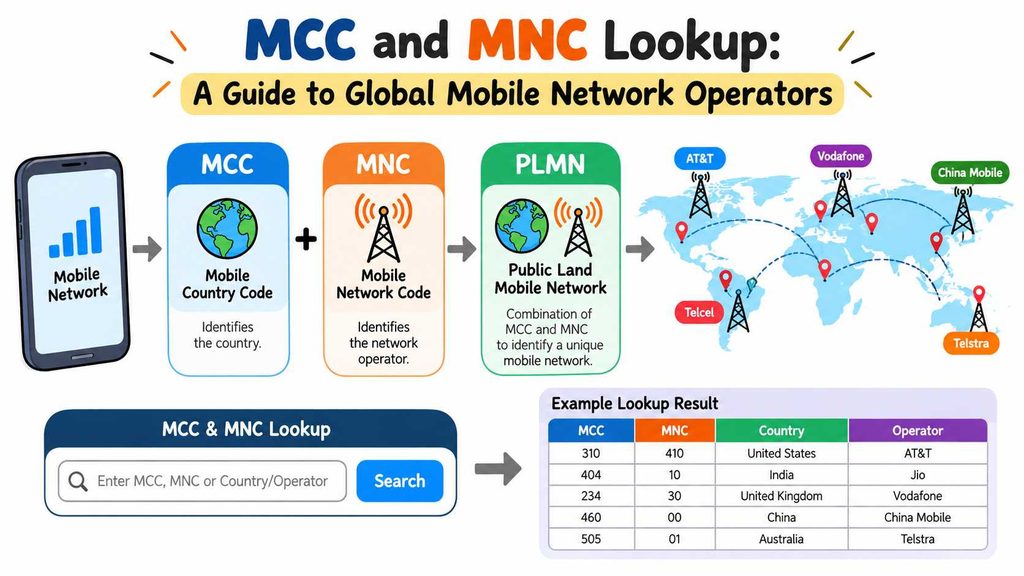
Mobile networks connect people across countries, cities, and regions. Behind these connections, telecom systems use special codes to identify countries and mobile network operators. Three important terms are Mobile Country Code (MCC), Mobile Network Code (MNC), and Public Land Mobile Network (PLMN).
These codes help telecom professionals, developers, researchers, and businesses organize mobile network information. They also support network research, connectivity analysis, and telecom database management. However, finding accurate information can become difficult when you research operators across different markets.
A reliable telecom directory can make this task easier. eSIMGlobo helps users explore global mobile network operators, telecom identifiers, and provider information. This guide explains how MCC, MNC, and PLMN work, how to research network codes, and what to check before using telecom data.
What Are MCC, MNC, and PLMN?
MCC, MNC, and PLMN serve related purposes in mobile communications. Each term describes a different part of mobile network identification.
Mobile Country Code (MCC)
MCC stands for Mobile Country Code. It uses three digits to identify a country or geographic region within mobile network systems.
Telecom databases use MCC values to organize network information by country or region. This makes it easier to narrow searches when researching mobile operators.
Mobile Network Code (MNC)
MNC stands for Mobile Network Code. It identifies a mobile network operator within a country or region.
The MNC works with the MCC to help distinguish one network from another. MNC formats can vary across markets, so users should check the relevant network information before interpreting a code.
Public Land Mobile Network (PLMN)
PLMN stands for Public Land Mobile Network. It refers to a public mobile network that supports services such as voice calls, messaging, and mobile data.
A PLMN identity commonly combines an MCC and an MNC. Together, these identifiers help systems recognize a particular mobile network.
Why Do Mobile Network Codes Matter?
Network codes support several activities across the telecom industry. They help people research operators, organize records, and understand mobile connectivity.
Telecom Research
Researchers use network identifiers to study mobile operators across countries. They can organize information by country, operator, and network identity.
A structured directory makes this research easier to manage.
Software Development
Developers may use network information in applications that support diagnostics, testing, or connectivity analysis. They can match available network identifiers with relevant operator records.
Developers should follow applicable platform rules and privacy requirements when accessing device or network information.
Roaming Analysis
Telecom teams may examine network identifiers when investigating roaming behavior. These codes can help them understand which network a device detects or uses.
However, a code lookup cannot confirm roaming access, coverage, or service quality. Teams must verify those details separately.
eSIM Research
Travelers and connectivity researchers may use network information to investigate eSIM providers and their network partners.
A provider may work with several operators across different destinations. Users should check the provider’s published coverage and plan details before choosing a service.
Telecom Database Management
Businesses may use MCC and MNC records to organize operator information. Consistent records can help teams search, compare, and review network data.
MCC vs. MNC vs. PLMN: Key Differences
Although these terms work together, they have different roles. The following table provides a quick comparison.
| Feature | MCC | MNC | PLMN |
|---|---|---|---|
| Full form | Mobile Country Code | Mobile Network Code | Public Land Mobile Network |
| Main purpose | Identifies a country or geographic region | Identifies a mobile network operator within that context | Identifies a public mobile network |
| Typical format | Three digits | Length varies by market | Commonly combines MCC and MNC |
| Main use | Country-level network research | Operator-level network research | Mobile network identification |
| Common users | Researchers and telecom teams | Developers and telecom professionals | Network engineers and telecom systems |
| Important limitation | Does not identify the operator alone | Requires the relevant country or network context | Does not guarantee coverage or connectivity |
This comparison helps readers understand the role of each identifier. When researching a specific operator, check the MCC and MNC together.
Additional Telecom Terms You Should Know
Mobile network directories may include several other terms. Understanding them helps you explore the wider telecom ecosystem.
| Term | Full Form or Meaning | Main Role |
|---|---|---|
| MNO | Mobile Network Operator | Operates a mobile network and provides wireless services |
| MVNO | Mobile Virtual Network Operator | Offers mobile services using another operator’s network in many cases |
| eSIM | Embedded SIM | Supports digital SIM profiles on compatible devices |
| eSIM Provider | A provider of eSIM services or connectivity plans | Offers digital connectivity options |
| MCC MNC Lookup API | An API for retrieving mobile network information | Helps software access network records, depending on the service |
| Telecom Directory | A collection of telecom provider information | Helps users research operators and network identifiers |
These terms describe different parts of mobile connectivity. For example, an eSIM provider may sell a plan that connects through a separate mobile network operator.
How to Find MCC and MNC Codes
You can follow a straightforward process to research a mobile network. The available search options depend on the directory or database you use.
Step 1: Select the Country
Start with the country or region you want to research. This narrows your search to relevant operators.
If you already know the operator’s name, keep it ready for the next step.
Step 2: Search for the Operator
Open a telecom directory or network database and search for the operator. Depending on the service, you may search by country, provider name, or network identifier.
Choose a directory that clearly connects each record with the relevant operator.
Step 3: Check the MCC
Review the MCC associated with the network. Confirm that the country or geographic region matches your research needs.
Do not assume that the same brand always uses the same network identity in every country.
Step 4: Verify the MNC
Find the MNC associated with the operator. Some markets may use multiple network identifiers, so check the specific record carefully.
When accuracy matters, compare the result with reliable operator or regulator information.
Step 5: Review the PLMN Identity
Use the MCC and MNC together to understand the network identity. Review any additional information the directory provides.
Verify important records before using them in technical projects, reports, or business decisions.
What Makes a Mobile Network Directory Useful?
A useful telecom directory should make network information easy to find and understand. Consider these features when choosing a directory for research.
Country and Operator Search
Country filters help users narrow results to a particular market. Operator search helps them locate a specific provider.
These features save time when researching networks across several countries.
Clear Network Identifiers
A directory should present identifiers in a clear and consistent format. It should also explain which operator or network each record describes.
Clear labels help users avoid confusing MCC values with MNC values.
Information About Provider Types
A directory may include information about MNOs, MVNOs, and other telecom providers. These details help users understand the difference between network operators and service brands.
Check which provider details the directory actually includes rather than assuming every record contains the same information.
Transparent Data Limitations
Telecom information can change over time. Some records may also lack update dates or complete details.
Review the available documentation before treating a record as current or complete.
Understanding MNOs, MVNOs, and eSIM Providers
Mobile connectivity involves different types of businesses. Their roles can overlap, but they do not always provide the same services.
Mobile Network Operators
An MNO operates a mobile network and provides wireless communication services. Its network may support calls, messaging, and mobile data.
MCC and MNC information can help researchers identify the network associated with an operator.
Mobile Virtual Network Operators
An MVNO offers mobile services through arrangements with another network operator in many cases. It may use its own brand, pricing, and customer service model.
The MVNO’s brand does not necessarily identify the company that operates the underlying network infrastructure.
eSIM Providers
An eSIM provider offers digital SIM services or connectivity plans. Depending on its business model, it may work with one or more mobile network operators.
When researching an eSIM plan, check the supported countries, network partners, device requirements, and plan conditions.
How Network Codes Help With eSIM Research
eSIM technology allows compatible devices to use digital SIM profiles. Travelers and local users can use supported eSIM plans to access mobile connectivity.
MCC and MNC information can help users research operators associated with a destination or service. It can also support telecom market research and provider comparisons.
However, network codes cannot answer every question about an eSIM plan. Review these details before choosing a service.
- Destination coverage: Confirm that the provider supports your destination.
- Network partners: Check which operators provide connectivity in that location.
- Device compatibility: Make sure your device supports eSIM technology.
- Data allowance: Review the data limit, validity period, and plan conditions.
- Service restrictions: Check whether the plan supports the services you need.
These checks help you understand the service beyond its network identifiers.
When Should Developers Use an MCC MNC Lookup API?
Developers may need telecom information inside an application or business system. An MCC MNC lookup API can help software retrieve network records when the provider offers that capability.
An API allows different software systems to exchange data. A telecom lookup API may match network identifiers with operator records.
Before choosing an API, review the following factors.
| Evaluation Factor | What to Check | Why It Matters |
|---|---|---|
| Country coverage | Countries and operators included in the database | Helps you assess whether the data fits your project |
| Documentation | Instructions for requests and responses | Makes integration easier |
| Data format | Format of the returned information | Helps your application process the data |
| Update process | How the provider maintains its records | Helps you assess data freshness |
| Usage limits | Request limits and access conditions | Helps you plan expected usage |
| Pricing | Published plans and charges, if available | Helps you estimate costs |
| Data quality | Whether records match trusted information | Reduces the risk of incorrect results |
Not every telecom directory offers an API. Check the provider’s published features and documentation before planning an integration.
Common Mistakes to Avoid During Network Code Research
Small mistakes can affect the accuracy of your research. Avoid these common problems when reviewing mobile network information.
Confusing MCC and MNC
MCC identifies a country or geographic region. MNC identifies a mobile network operator within that context.
Treating these codes as interchangeable can create incorrect database records.
Assuming Every Provider Owns a Network
Some eSIM providers and MVNOs use infrastructure operated by other companies. Their service brands do not always represent the underlying network operator.
Check the provider’s role before drawing conclusions.
Using Outdated Records
Telecom information can change as operators update their services or network arrangements. An old directory entry may no longer reflect the current situation.
Look for update information and verify important records.
Treating Network Codes as Proof of Coverage
An MCC and MNC help identify a network. They do not guarantee that a device can connect to it.
Coverage and access may depend on local availability, roaming arrangements, device compatibility, and plan conditions.
Ignoring Country-Specific Differences
Network identifier formats and assignments can vary across markets. Use the relevant country and network context when checking a record.
Do not assume that one country’s rules apply everywhere.
Explore Global Telecom Information With eSIMGlobo
Finding useful telecom information becomes easier when you have a clear starting point. A global directory can help you explore mobile operators, network identifiers, and provider information across different markets.
Visit eSIMGlobo to explore its global telecom directory and research mobile network information. The platform focuses on helping users discover and understand network operators, telecom identifiers, and related provider details.
Use directory information as a starting point. For technical work or important business decisions, confirm critical details with official operator or regulator records.
Best Practices for Managing Telecom Network Data
Businesses and developers may store network information in their own systems. A consistent process helps them maintain clear and useful records.
Store MCC and MNC Separately
Keep the MCC and MNC in separate fields. This makes searches, filtering, and comparisons easier.
You can also store the combined PLMN identity when your project requires it.
Record Country and Operator Names
Connect each network record with its country and operator name. These details help users understand the record without decoding the numbers manually.
Apply consistent naming rules across the database.
Track Sources and Updates
Record where each entry came from and when your team last checked it. This helps you identify information that needs review.
If the provider does not publish an update date, do not assume the record remains current.
Verify Important Changes
Check new or changed entries before using them in production systems. For high-impact projects, compare the information with official telecom records.
A clear review process can help reduce data errors.
How Mobile Network Directories May Evolve
Mobile connectivity continues to develop as operators expand services and providers introduce new ways to connect users. eSIM adoption and connected devices also create demand for clear telecom information.
Directories can help users organize operator details and network identifiers. APIs can help developers connect that information with applications and internal databases.
However, useful tools still depend on reliable data. Users should review data coverage, update practices, and source quality before relying on a directory for important decisions.
Frequently Asked Questions
1. What is an MCC code?
MCC stands for Mobile Country Code. It uses three digits to identify a country or geographic region within mobile network systems.
2. How does an MNC code work?
MNC stands for Mobile Network Code. It helps identify a mobile network operator within a country or region and commonly works with an MCC.
3. What does PLMN mean?
PLMN stands for Public Land Mobile Network. Its identity commonly combines MCC and MNC information to identify a public mobile network.
4. Where can I search for MCC and MNC codes?
You can use a telecom directory or network database. For important decisions, verify the results with official operator or regulator information.
5. Do MCC and MNC values have the same format everywhere?
MCC uses three digits, while MNC length can vary by market. Check the relevant network standard and country context when interpreting an identifier.
6. Does every eSIM provider have its own network codes?
No. Some eSIM providers offer connectivity through partner operators. The underlying network may have different identifiers from the eSIM provider’s brand.
7. Can an MCC MNC lookup tell me whether a network has coverage?
No. A lookup helps identify a network, but it does not confirm signal strength, coverage, roaming access, or plan availability.
8. What does an MCC MNC lookup API do?
An MCC MNC lookup API can help software retrieve or match network information. Its coverage and features depend on the API provider.
9. Why should I check telecom records before using them?
Network information can change, and some directories may contain incomplete records. Verification helps reduce the risk of using outdated or incorrect details.
10. Where can I explore global mobile network operators?
You can start your research with to explore its global telecom directory and related network information.
Final Thoughts
Mobile network identifiers help people understand how telecom systems organize countries, operators, and public mobile services. MCC identifies a country or region, MNC helps identify an operator, and PLMN represents a public mobile network identity.These identifiers support telecom research, software development, eSIM comparisons, and network analysis. However, users should verify important details instead of relying on a code alone.For a starting point in global telecom research, Combine directory research with trusted records to make better-informed decisions.
Leave a Reply