SRESchool.in: A Practical Guide to SRE Learning, Reliability, and Operations
Introduction
A production system tells engineers much more than a development environment ever can. Real users create unpredictable traffic, real dependencies fail, and small configuration mistakes can sometimes create large operational problems.SRE helps engineers prepare for those situations.
Site Reliability Engineering combines software engineering, infrastructure, monitoring, automation, and operational practices to improve the reliability of services. It gives teams a practical way to measure system behavior and respond to problems instead of relying entirely on manual firefighting.
For people exploring SRE Training, SRE Certification, or an SRE Course, the learning journey should focus on how these ideas work together. SRESchool.in covers learning areas connected with reliability engineering, cloud systems, observability, automation, monitoring, and production operations.
The objective should remain practical: understand systems, recognize reliability risks, solve operational problems, and improve the way services run.
What Is Site Reliability Engineering and Why Does It Matter?
Site Reliability Engineering applies engineering methods to operational reliability.
Consider an online service that works normally for several hours and then starts returning errors when traffic increases. An operations team might restore the service first. An SRE approach goes further.
Engineers can examine traffic patterns, resource consumption, application behavior, dependencies, alerts, and capacity. They can then improve the system instead of repeatedly fixing the same symptom.
SRE matters because reliability affects the actual user experience.
A technically impressive application still creates problems if users regularly encounter failed requests, long delays, unavailable features, or unpredictable behavior.
What Can You Learn Through SRE Training?
A practical SRE Training journey can cover the full lifecycle of operating a service.
Learners can study:
- Reliability principles
- Service Level Indicators
- Service Level Objectives
- Service Level Agreements
- Error budgets
- Monitoring
- Alerting
- Observability
- Incident response
- Automation
- Capacity planning
- Cloud infrastructure
- Distributed systems
- Troubleshooting
- Deployment practices
The learning becomes stronger when learners connect each concept to an operational situation.
For instance, an SLO gives a team a reliability target. Monitoring provides evidence about current behavior. An incident process helps the team respond when performance deteriorates, while automation can reduce repetitive recovery work.
What Is SRE Certification and Why Do Professionals Consider It?
SRE Certification can give professionals a structured framework for studying reliability engineering and testing their understanding.
The exact content differs between certification providers. Some programs may emphasize theory, while others may include practical exercises or assessments.
Before selecting a certification, check:
- Curriculum
- Exam format
- Practical requirements
- Prerequisites
- Learning resources
- Assessment method
- Certification conditions
Certification can help organize learning, but production engineering requires more than examination knowledge.
An SRE Engineer also needs to troubleshoot unfamiliar situations, understand infrastructure, work with developers, communicate during incidents, and make sensible reliability decisions.
How to Choose an SRE Course
Choosing an SRE Course becomes easier when you start with your own skill level.
A beginner and an experienced DevOps professional should not necessarily follow the same learning path.
Use the following checklist:
| Area | What to Evaluate |
|---|---|
| Starting level | Does the course fit your technical background? |
| SRE fundamentals | Does it explain reliability concepts clearly? |
| Practical work | Does it include exercises or realistic scenarios? |
| Monitoring | Does it explain useful system signals? |
| Incident response | Does it cover detection and recovery? |
| Automation | Does it show how to reduce repetitive work? |
| Cloud | Does it explain reliability in cloud environments? |
| Tools | Does it explain practical tool usage? |
Also check whether the course teaches the reasoning behind each practice. Memorizing commands without understanding their purpose limits long-term learning.
What Is Site Reliability Engineering Training?
Site Reliability Engineering Training teaches engineers how to approach reliability as an ongoing engineering responsibility.
Training can start with simple concepts such as availability, latency, and service health. From there, learners can move into SLOs, monitoring, observability, incident management, automation, and capacity planning.
A useful exercise might involve a service that suddenly becomes unavailable.
The learner needs to determine:
- How the failure was detected
- Which users experienced the problem
- What the available evidence shows
- Which dependency may have failed
- How engineers can restore the service
- What changes could reduce future risk
This type of practice turns abstract SRE concepts into practical problem-solving skills.
Understanding Site Reliability Engineering Certification
A Site Reliability Engineering Certification can provide a formal learning structure for professionals who want to study SRE concepts systematically.
Certification preparation can cover topics such as reliability measurement, service objectives, incident management, automation, monitoring, and operational risk.
However, every certification program has its own structure.
Learners should verify the specific requirements before enrolling. Factors such as prerequisites, assessment format, practical work, study material, and renewal conditions can differ.
Professionals should also connect certification study with hands-on practice. Reading about incident response is useful, but working through a simulated incident provides a different level of understanding.
How SRE Tutorials Can Help You Learn
An SRE Tutorial can simplify a large topic by focusing on one practical problem.
Suppose the subject involves monitoring. Instead of studying monitoring as a broad definition, a tutorial can show how an engineer chooses useful metrics, creates an alert, investigates an abnormal value, and decides whether the alert needs action.
The same learning style can apply to:
- SLOs
- Error budgets
- Logging
- Observability
- Automation
- Incident response
- Cloud reliability
- Kubernetes
- Terraform
Tutorials also work well for revision because learners can return to individual concepts whenever they need additional practice.
SRESchool.in includes learning areas related to these subjects, allowing learners to explore reliability concepts alongside supporting technologies and operational practices.
Understanding SRE Tools and Their Uses
Engineers use SRE Tools to observe systems, identify problems, manage infrastructure, and automate operational activities.
The tools can be grouped by purpose.
| Category | Typical Use |
|---|---|
| Monitoring | Track system and service behavior |
| Logging | Search application and infrastructure events |
| Tracing | Follow requests across distributed services |
| Alerting | Notify engineers about important conditions |
| Infrastructure as code | Manage infrastructure configurations |
| Containers | Package and operate applications |
| Automation | Execute repeatable operational tasks |
| Incident management | Coordinate response activities |
Tool selection should start with the operational requirement.
A team should understand what it needs to observe, automate, troubleshoot, or manage before choosing a specific product.
This approach also makes technical skills more transferable because the underlying concepts remain useful when organizations change tools.
What Are SRE Best Practices?
SRE Best Practices help teams build consistent reliability habits.
Some practical examples include:
- Measure important user-facing behavior.
- Set clear reliability objectives.
- Keep alerts actionable.
- Remove unnecessary alert noise.
- Automate repetitive tasks carefully.
- Maintain useful operational documentation.
- Prepare incident response procedures.
- Review incidents after service recovery.
- Track recurring failures.
- Use capacity information when planning infrastructure.
Another important practice involves separating recovery from prevention.
Restarting a service can restore functionality. It does not necessarily explain why the service failed.
A strong post-incident process asks what conditions created the failure and what engineering changes can reduce the chance of seeing the same problem again.
What Does an SRE Engineer Do?
An SRE Engineer works on the reliability and operational health of software services.
The exact role varies by organization, but responsibilities may include:
- Monitoring production systems
- Investigating incidents
- Improving observability
- Automating repetitive operations
- Supporting deployments
- Managing infrastructure
- Reviewing system performance
- Improving alerting
- Planning capacity
- Documenting operational procedures
SRE work also involves collaboration.
An incident may involve developers, infrastructure engineers, security teams, database specialists, and business stakeholders. The SRE Engineer often needs to communicate technical information clearly while the team works toward recovery.
Understanding SLOs, SLIs, SLAs, and Error Budgets
SRE uses several related terms to make reliability measurable.
SLI describes a measurement of actual service behavior. A team might measure successful requests, latency, or another relevant service characteristic.
SLO defines the target for that measurement.
SLA represents a formal agreement that can establish service commitments between a provider and customer.
Error budget provides a way to think about how much unreliability fits within an SLO.
These concepts help teams move away from vague statements about reliability.
Instead of simply saying that a service should be “highly available,” engineers can define what they want to measure and what target they want to maintain.
How Monitoring and Observability Help SRE Teams
Monitoring helps engineers watch known conditions.
A dashboard might show request volume, latency, errors, resource usage, or other selected signals. Alerts can notify engineers when a defined condition requires attention.
Observability addresses a different need: investigation.
Imagine that users report intermittent failures, but the main server metrics look normal. Engineers may need logs, traces, dependency information, and application-level data to understand what is happening.
That is where observability becomes useful.
Monitoring can help answer “Is something wrong?”
Observability can provide evidence for “Why might this be happening?”
Both approaches support faster and more informed troubleshooting when teams design them around meaningful operational questions.
Understanding Incident Management and Incident Response
A production incident can become confusing quickly when several engineers investigate the same problem without clear coordination.
Incident management introduces structure.
A response can involve:
- Detecting the issue
- Confirming the impact
- Assigning responsibilities
- Investigating available evidence
- Taking recovery actions
- Communicating relevant updates
- Restoring normal operation
- Recording the incident
- Reviewing the event afterward
Preparation matters as much as response.
Runbooks, escalation procedures, reliable alerts, ownership information, and recovery exercises can reduce confusion when an actual incident occurs.
Afterward, teams should focus on learning and system improvement rather than personal blame.
How Automation Can Reduce Repeated Work
Manual work often provides the first clue that automation could help.
Suppose engineers repeatedly perform the same checks after every deployment. A suitable automated workflow might perform those checks consistently and report the results.
Automation can support:
- Deployment verification
- Infrastructure provisioning
- Configuration changes
- Health checks
- Routine maintenance
- Log analysis
- Alert enrichment
- Repeated recovery procedures
Good automation needs clear boundaries.
Teams should test automated actions, monitor their results, and add approval or safety mechanisms when an incorrect action could cause significant impact.
The goal is not to automate everything. The goal is to automate work where automation improves consistency, speed, or reliability.
Understanding Cloud Reliability and Distributed Systems
Cloud environments often connect many services together.
A single application may depend on databases, queues, APIs, storage, identity systems, networks, and external services. That dependency chain can create unexpected failure paths.
Distributed systems can introduce challenges involving:
- Network delays
- Partial failures
- Service dependencies
- Capacity limits
- Data consistency
- Timeouts
- Retry behavior
- Recovery
SRE engineers need to understand these interactions.
A service can appear healthy from one perspective while still causing problems for another component. Good reliability practices therefore examine dependencies and user-facing behavior rather than focusing only on individual machines.
How Kubernetes and Terraform Can Support SRE Work
Kubernetes and Terraform can contribute to repeatable infrastructure and application operations, but they solve different problems.
Kubernetes provides mechanisms for running and managing containerized workloads.
Terraform supports infrastructure as code, allowing infrastructure configurations to follow a defined and repeatable process.
SRE learners should study these technologies in context.
For Kubernetes, that can include understanding workloads, service behavior, resources, health checks, and operational visibility.
For Terraform, learning can include infrastructure definitions, configuration changes, repeatability, and controlled infrastructure management.
Neither technology removes the need for sound reliability practices.
How to Build a Simple SRE Learning Path
A learner can organize SRE study into several practical stages.
Build the Foundation
Start with Linux, networking, HTTP, DNS, processes, storage, and basic troubleshooting.
Understand Infrastructure
Learn how compute, networking, storage, identity, and cloud resources work together.
Study Reliability Principles
Move into SLIs, SLOs, SLAs, error budgets, availability, latency, and service health.
Learn System Visibility
Practice metrics, logs, dashboards, alerts, and observability concepts.
Develop Troubleshooting Skills
Work through failures involving applications, infrastructure, dependencies, and resource constraints.
Introduce Automation
Identify repetitive tasks and build small, controlled automation workflows.
Practice Incident Response
Use simulated incidents to practice detection, investigation, communication, recovery, and review.
Expand Your Technical Scope
Once the foundations become comfortable, explore Kubernetes, Terraform, distributed systems, capacity planning, and other relevant technologies.
Understanding SRE Training in India
SRE Training in India can support professionals who want to build knowledge around production reliability and modern infrastructure practices.
Learners may enter this field from different technical backgrounds. Developers, DevOps engineers, cloud professionals, system administrators, and infrastructure specialists can all approach SRE from different starting points.
That makes course selection important.
Someone with limited infrastructure experience may benefit from foundational material. Someone already comfortable with DevOps tools may need deeper study of reliability measurement, incident management, observability, and service objectives.
When comparing training programs, examine the actual curriculum, practical activities, teaching method, learning format, and assessment approach.
Training can support professional development, but no course should be treated as a guaranteed path to a specific job, salary, or promotion.
How SRESchool.in Supports SRE Learning
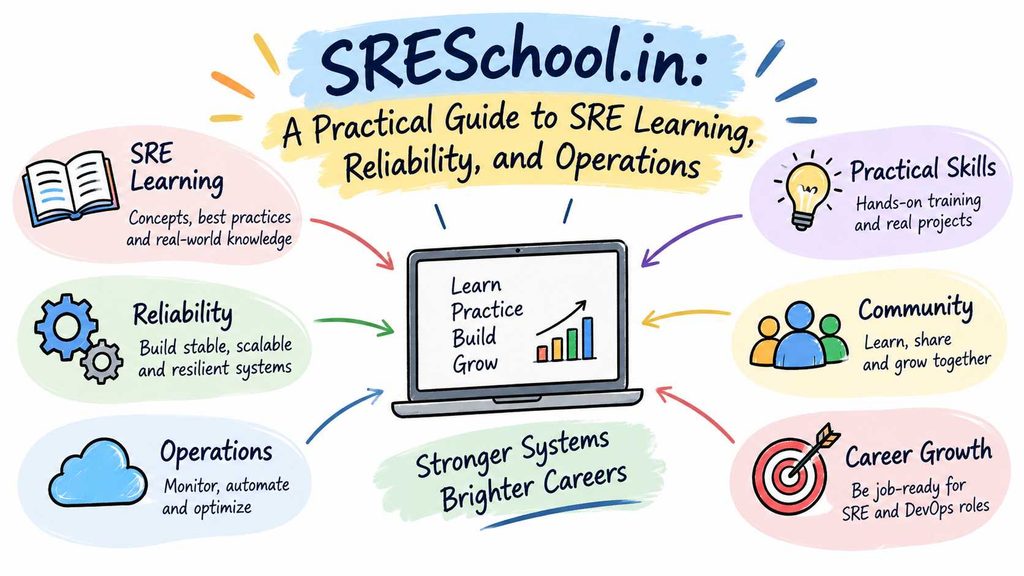
SRESchool.in focuses on learning areas associated with Site Reliability Engineering and production technology.
Its stated subject areas include:
- SRE Training
- SRE Certification
- SRE Course concepts
- Site Reliability Engineering Training
- Site Reliability Engineering Certification
- SRE Tutorials
- SRE Tools
- SRE Best Practices
- Monitoring
- Observability
- Automation
- Cloud systems
- Kubernetes
- Terraform
This combination allows learners to explore SRE as a broader engineering discipline rather than treating it as only a monitoring topic.
For anyone considering a particular course or certification, the relevant program information should remain the source for exact curriculum, delivery, assessment, and certification details.
Why Learning SRE Is Becoming More Useful
Software reliability depends on many connected engineering decisions.
Application design affects performance. Infrastructure affects availability. Monitoring affects detection. Automation affects operational consistency. Incident practices affect recovery. Capacity planning affects how systems handle changing demand.
SRE brings these areas into one reliability-focused approach.
The skills can also support several technology roles. Developers can use SRE principles when building production-ready applications. DevOps engineers can connect automation with service objectives. Cloud engineers can apply reliability thinking to infrastructure design.
Learning SRE therefore provides more than knowledge of a particular toolset. It encourages engineers to understand how systems behave after deployment and how teams can improve that behavior over time.
Frequently Asked Questions About SRESchool.in
1. What is SRESchool.in designed to teach?
SRESchool.in focuses on Site Reliability Engineering and related subjects such as cloud reliability, monitoring, observability, automation, incident management, and production systems.
2. What topics should an SRE beginner learn first?
Linux, networking, basic programming or scripting, cloud fundamentals, system administration, and basic troubleshooting can provide a useful foundation.
3. What can I expect from SRE Training?
SRE Training can cover reliability principles, SLOs, SLIs, error budgets, monitoring, observability, incidents, automation, cloud systems, and operational practices.
4. Is SRE Certification the same as practical SRE experience?
No. Certification can assess structured knowledge, while practical experience involves troubleshooting systems, managing incidents, working with infrastructure, and making engineering decisions.
5. How can I select an SRE Course?
Compare the course level, syllabus, practical exercises, monitoring coverage, incident-response material, automation topics, infrastructure content, and assessment method.
6. What are the main categories of SRE Tools?
Common categories include monitoring, logging, tracing, alerting, infrastructure management, container platforms, automation, and incident management.
7. Why do SRE teams use SLOs?
SLOs provide defined reliability targets. They help teams measure service performance and make reliability discussions more concrete.
8. What does an SRE Engineer handle during an incident?
Responsibilities can include understanding impact, investigating evidence, coordinating technical work, helping restore service, communicating status, and supporting follow-up improvements.
9. Are Kubernetes and Terraform required for every SRE role?
No. Technology requirements vary between organizations. Kubernetes and Terraform can be useful in environments that use them, but SRE fundamentals apply more broadly.
10. What should I check before joining SRE Training in India?
Review the course syllabus, practical coverage, learning format, instructor approach, prerequisites, assessments, and whether the material matches your current experience and learning goals.
Final Thoughts
SRE learning becomes much more meaningful when technical concepts connect with real operational questions.
Why did the service fail? Could engineers have detected the problem earlier? Which signal mattered? What work should the team automate? How can the architecture handle the next failure more effectively?
Those questions encourage the engineering mindset that sits behind Site Reliability Engineering.
SRESchool.in can support learners exploring SRE Training, SRE Certification, SRE Course, Site Reliability Engineering Training, SRE Tutorials, SRE Tools, and SRE Best Practices.
The broader learning journey should move from fundamentals to practice. Once learners understand how reliability measurements, monitoring, incidents, automation, infrastructure, and system design connect, they can approach production problems with greater structure and clarity.
Leave a Reply